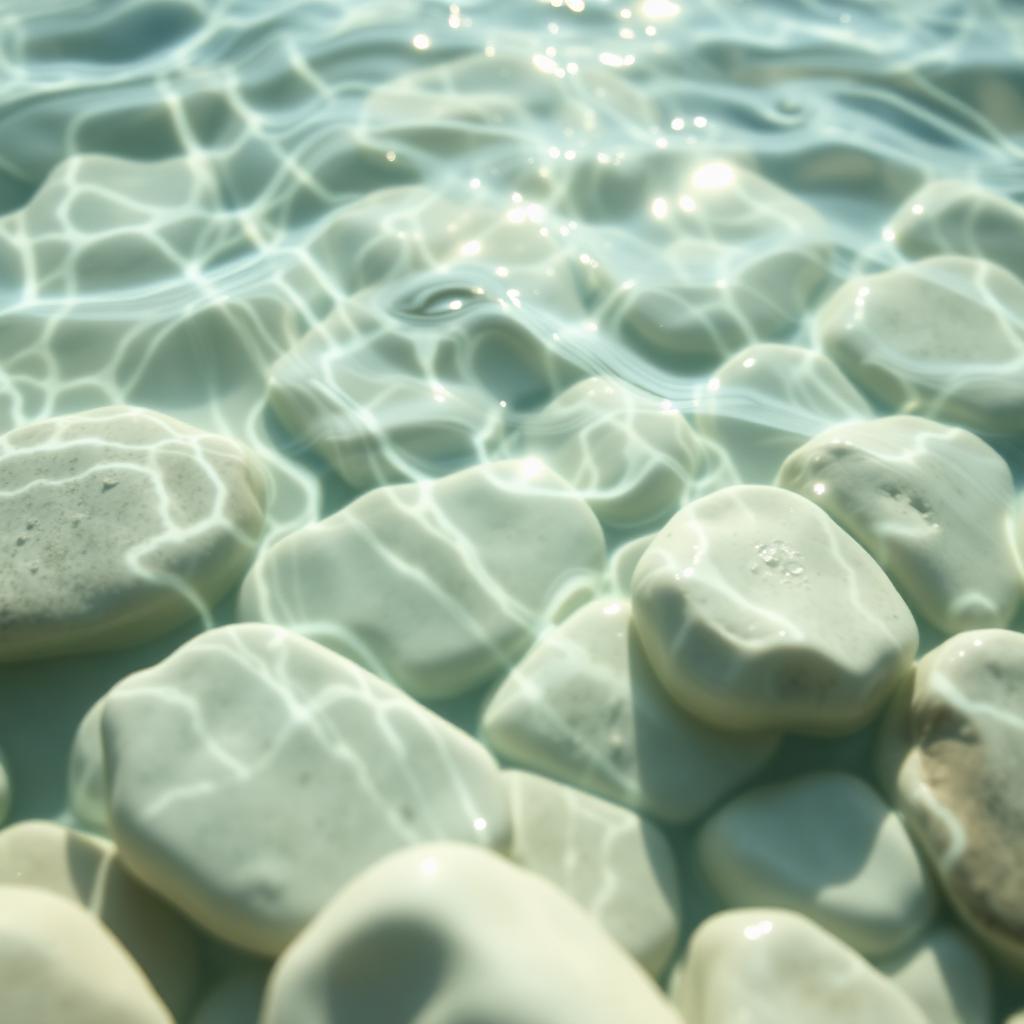
Before there were roads, borders, cities, nations or names, there was water.
Before any of us took our first breath, water was already moving across the face of the Earth. It rose from oceans as vapour, gathered in clouds, fell as rain, disappeared into soil, travelled through stone, entered roots, flowed through rivers and returned again to the sea.
Water does not remain still for long.
It changes form, but it continues.
The water we hold today is part of a cycle far older than human memory. It may once have fallen upon an ancient forest, moved beneath a mountain, rested in a glacier, passed through the roots of a tree, filled the body of an animal, or sustained generations of people whose names have long disappeared.
That does not mean that a glass of water contains a recognisable record of every life it has touched. Science has not established that water stores personal memories in that literal sense, however there is scientific evidence that water has a memory...
Yet spiritually, water carries something profound.
It carries continuity.
It reminds us that very little in existence is truly isolated. What appears separate is often only passing temporarily through a different form.
The rain is not separate from the sea.
The river is not separate from the cloud.
The spring is not separate from the mountain.
The water within us is not separate from the living Earth.
We borrow it.
For a short time, water becomes part of our blood, our cells, our tears, our breath and our thoughts. It carries nutrients through us. It regulates our temperature. It cushions our organs. It allows the chemistry of life to take place.
Then it moves on.
Perhaps this is the first wisdom of water:
Nothing Truly Belongs to Us
We speak of “my body,” “my land,” “my life,” and “my water,” but water teaches that possession is temporary.
We hold it for a while.
We receive it, depend upon it and eventually return it.
Water passes through the powerful and the powerless alike. It sustains the king and the child, the stranger and the friend, the person we love and the person we struggle to understand.
It cannot be permanently owned in its deepest sense.
It can only be received, respected and passed forward.
Water asks us:
«What are you holding too tightly?»
«What are you trying to possess that was only ever entrusted to your care?»
«Can you receive life gratefully without trying to control every part of it?»
Water Remembers Through Relationship
Perhaps the deepest form of memory is not the storage of pictures or words.
Perhaps memory is relationship.
Water shapes the land it repeatedly touches. Rivers carve valleys. Rain nourishes forests. Waves reshape coastlines. Underground water dissolves minerals and carries them onward. The history of water can be seen in the pathways it creates.
Water does not need a human mind to leave a record.
Its journey is written into the world.
The stone remembers the river through the channel carved into it.
The tree remembers the rain through every ring of growth.
The body remembers water through its continued ability to live.
In this sense, water’s memory is not necessarily a hidden recording inside each molecule.
Its memory is revealed through consequence.
Everything water touches is changed by the relationship.
And perhaps we are the same.
We carry the people who have touched our lives, not as perfect recordings, but in the ways they shaped us. A parent may remain in our gestures. A grandparent may remain in our values. Someone we have lost may remain in the courage, tenderness or wisdom they awakened within us.
They are not physically present in the form we once knew.
But the channel they carved remains.
The Water of Our Ancestors
There is something humbling in imagining that the water within us belongs to an ancient planetary cycle.
The water sustaining our bodies today may once have sustained people who came before us. It may have fallen as rain upon the homes of our ancestors. It may have run through the streams from which they drank. It may have nourished the crops that became their food.
We cannot trace a particular drop and declare with certainty whose body it entered or what moment it witnessed.
But we can recognise the greater truth:
We are participating in the same living cycle.
The water that sustained earlier generations still moves through the world. Nothing guarantees that the precise water in our glass belonged to someone we loved, yet every glass connects us to the same ancient system that held them.
This is not ownership of their memory.
It is communion with continuity.
When we drink water mindfully, we may pause and remember:
«I am sustained by the same Earth that sustained those who came before me.»
«The life moving through me is not new.»
«I belong to a story far larger than my individual years.»
Water Does Not Resist Its Nature
Water is gentle, yet it shapes stone.
It does not always overcome through force. It persists.
When blocked, it gathers.
When given an opening, it flows.
When heated, it rises.
When cooled, it becomes still.
When frozen, it expands.
When released, it finds a path.
Water adapts without ceasing to be water.
This may be one of its greatest teachings.
Human beings often believe strength means rigidity. We hold our position, defend our identity and resist change because we fear that adaptation means weakness.
But water shows us another form of strength.
To adapt is not necessarily to surrender.
To move around an obstacle is not the same as being defeated by it.
To become still is not to become powerless.
To change form is not to lose one’s essence.
Water asks:
«Can you remain true to your deepest nature while changing the form through which you move?»
«Can you stop wasting your strength against what cannot yet be moved?»
«Can you find another path without abandoning your purpose?»
Water Teaches Release
Water becomes stagnant when it cannot move.
A healthy river receives and releases. It does not try to keep every drop that enters it.
Human beings often suffer because we hold what was meant to move through us.
We hold anger.
We hold grief.
We hold betrayal.
We hold words that were spoken years ago.
We hold identities that no longer fit.
We hold responsibility for things that were never ours to carry.
Water invites us to release without denying what happened.
Release does not mean pretending there was no wound.
It means refusing to build our permanent home inside the wound.
A river carries fallen branches, soil and broken leaves, but it does not stop being a river.
We too can carry experience without becoming entirely defined by it.
Perhaps forgiveness is not declaring that harm was acceptable.
Perhaps forgiveness is restoring movement where pain created stagnation.
What we release no longer controls the whole course of our lives.
Tears Are Water Speaking Through Us
Our bodies produce tears when language becomes insufficient.
We cry through grief, relief, pain, love, exhaustion and joy.
Tears are not evidence of weakness. They are evidence that something within us is moving.
The body sometimes releases through water what the voice cannot yet explain.
A tear may contain no literal image of the person we miss, yet it carries the physical expression of remembrance. It is grief becoming movement. It is love refusing to remain entirely trapped inside the body.
Perhaps tears are one way water helps us return to ourselves.
They soften what has hardened.
They make visible what has remained hidden.
They remind us that sorrow and love often come from the same source.
We grieve because something mattered.
Asking Water for Its Wisdom
To ask water for wisdom does not require us to claim that water thinks as a human being thinks.
It means allowing water to become a mirror.
We can sit beside the sea, a river, a spring or even a simple glass of water and become quiet enough to notice what its nature teaches us.
We might hold the water and ask:
«What must I allow to flow?»
«What have I held for too long?»
«Where have I become stagnant?»
«What part of me needs cleansing rather than punishment?»
«Where am I being asked to adapt?»
«What truth is trying to rise within me?»
«What has life entrusted to me that I must protect and pass forward?»
«Which ancestors, loved ones and teachers still live through the good they placed within me?»
The answer may not come as a voice.
It may come as a memory, a feeling, a sudden clarity, a physical softening or a recognition we had previously avoided.
The wisdom is not necessarily coming from a supernatural message hidden in the glass.
It may arise because contemplation allows our own deeper consciousness to speak.
The water gives us a focus.
Its movement helps our thoughts move.
Its stillness invites our minds to become still.
Its clarity asks us to look honestly at what has clouded our own vision.
A Water Meditation
Take a clean glass of water and hold it gently.
Notice its weight.
Notice how something so ordinary is essential to every part of your life.
Consider how old the water cycle is and how briefly this water will remain within your care.
Then say:
Ancient water, traveller of the Earth,
you have moved through cloud, soil, stone and living form.
You remind me that life is movement, relationship and return.
Help me receive what nourishes me.
Help me release what no longer serves life.
Help me remain gentle without becoming weak.
Help me remain adaptable without losing my truth.
Help me remember that I belong to something greater than myself.
I honour those who came before me,
those whose lives shaped mine,
and those whose love still moves through the person I am becoming.
May this water nourish my body.
May reflection nourish my mind.
May gratitude nourish my spirit.
As water flows, may life flow through me with wisdom, integrity and peace.
Then drink slowly.
Not because the water has magically become medicine through words alone, but because attention changes the way we receive what was already life-giving.
The True Memory of Water
Perhaps water’s greatest memory is the cycle itself.
It remembers how to rise.
It remembers how to fall.
It remembers how to gather.
It remembers how to flow.
It remembers how to return.
And perhaps those are the things we most need to remember.
When life burns us, we can rise.
When grief brings us down, we can fall without believing we are finished.
When we are scattered, we can gather.
When something blocks us, we can seek a wiser path.
When we lose ourselves, we can return.
Water does not offer us proof that every thought, word or human life is stored within it forever.
It offers something quieter and perhaps more useful:
a living symbol of continuity.
The water within us connects us physically to Earth and symbolically to every generation that has depended upon the same cycle.
We are not separate from nature.
We are nature becoming conscious of itself for a brief moment.
We are ancient elements arranged temporarily into a human life.
And when we ask water for its wisdom, perhaps what we are really asking is:
«Help me remember what I am.»
Not isolated.
Not permanent.
Not separate.
But living, flowing, connected and entrusted with this moment.
Water’s wisdom is not that it holds on to everything.
Its wisdom is that it continues.